
Get 99.99% reliable VoIP with 30-50% cost savings, Microsoft Teams integration, and zero-downtime migration by UK experts who answer in under 90 seconds—not voicemail hell.
trusted by SMEs as well as the world's largest brands
.png)

You need business communications that don't fail when clients call—crystal-clear VoIP phone systems that work from any device, with direct UK expert support in under 90 seconds. AMVIA delivers 99.9% reliable VoIP with transparent pricing, zero-downtime migration, and features that actually improve productivity, not complicate it.

VoIP (Voice over Internet Protocol) phone systems enable your business to make and receive calls over your internet connection rather than traditional copper phone lines. Your voice converts to digital data packets and transmits via broadband, giving you the flexibility to communicate from any internet-connected device—desk phones, laptops, mobiles, or tablets.
This means your Manchester sales team, London office, and remote workers all use the same business phone system with identical features and call quality. No geographic limitations. No multiple phone bills. Just unified communications that scale with your business.
Why this matters now: The UK's traditional PSTN (Public Switched Telephone Network) is being permanently switched off by January 2027. Every business currently using analogue phone lines, ISDN circuits, or legacy PBX systems must migrate to digital telephony—and VoIP represents the most flexible, cost-effective solution available.

Switching to VoIP represents one of the most compelling telecommunications decisions modern businesses can make. Organizations that migrate to VoIP experience immediate, measurable financial benefits alongside transformative operational improvements that directly impact their bottom line.
Cost Reduction and Financial Impact - Businesses switching to VoIP realize significant savings, with most companies reporting cost reductions between 30% to 50% on annual communication expenses. More aggressive estimates show savings reaching 50–75% when fully consolidating voice, video, and unified communications onto VoIP platforms. The average business using VoIP saves approximately $1,200 per employee annually through reduced phone bills, lower infrastructure costs, and dramatically cheaper international calling rates. Call centers experience particularly substantial benefits, cutting operational costs by up to 30%. [SQ]
Scalability and Infrastructure Efficiency- Unlike traditional landline systems that require costly physical installation, maintenance, and wiring infrastructure, VoIP leverages existing internet connections. This eliminates expensive PBX hardware investments and ongoing maintenance fees while enabling businesses to scale seamlessly as they grow. Monthly costs typically range from $15–$40 per user—substantially lower than traditional alternatives.[SQ]
Productivity and Remote Work Enablement - VoIP systems save approximately 32 call minutes per employee daily through intelligent call routing, reduced transfers, and streamlined workflows. Small and medium enterprises adopting VoIP report 30% productivity increases, while 67% of mobile workers experience faster problem resolution. With 45% of companies citing remote work as a key driver for VoIP adoption, the technology has become essential for hybrid workforces. [techco]
Return on Investment - Businesses typically recoup their VoIP investment within 6–12 months. Customer data demonstrates an average 200%+ ROI within 12 months, with some organizations achieving payback in as little as 90 days. Global VoIP market growth—reaching $146.82 billion in 2025—reflects widespread business confidence in the technology's value proposition.Your competitors aren't waiting until 2027. They're switching now because VoIP delivers measurable business advantages traditional systems can't match. [frejun]

Your traditional phone system converts your voice into electrical signals traveling through copper wires. VoIP does something smarter: it converts your voice into compressed digital data packets that travel over your internet connection.
Here's what happens when you make a VoIP call:
- Your voice enters a VoIP-enabled device (desk phone, softphone app, or headset)
- Built-in codecs compress and digitize your voice into data packets
- Packets transmit via your broadband connection to the recipient
- Their device reassembles packets and converts them back to voice
- All this happens in milliseconds—you won't notice any delay with quality internet
This means:
- Calls to other VoIP users are free—even internationally
- Multiple conversations share the same internet connection without quality loss
- Advanced features like call recording, conferencing, and CRM integration become standard
- Your phone system becomes location-independent, supporting distributed teams seamlessly
The technical requirement: Business-grade broadband with sufficient bandwidth. For typical usage, 100Kbps per concurrent call provides excellent quality. A standard business broadband connection easily supports 20-30 simultaneous calls with bandwidth to spare.
AMVIA assesses your connectivity during implementation, recommending upgrades only when genuinely necessary. No forced upsells—just transparent technical guidance.



.avif)


Standard VoIP systems include 50+ features that legacy phone systems charge thousands to add. You're not paying extra for these—they're built into the platform because that's how modern communications work.
Core Communication Features
Auto Attendant (IVR): Your virtual receptionist answers 24/7, routing callers to the correct department via voice or keypad prompts. This means even two-person businesses present like enterprises, while larger operations reduce reception workload by 40%.
Call Queuing & Distribution: Incoming calls route to available team members based on skills, availability, or round-robin distribution. No more missed opportunities because everyone's on another call—customers wait in organized queues with hold music and estimated wait times.
Advanced Call Forwarding: Calls follow you anywhere—to mobile, home office, or colleague—based on rules you control. Out of office? Calls automatically route to your mobile. Busy? They roll to your teammate. On holiday? They divert to voicemail with email notification.
Call Recording & Transcription: Record conversations for training, compliance, or dispute resolution. Modern systems transcribe recordings automatically, making them searchable. This protects your business legally while improving service quality through coaching opportunities.
Voicemail to Email: Voicemails arrive as audio files in your inbox with AI-generated transcripts. You review them whenever convenient, never missing urgent messages because you didn't check your voicemail.
Collaboration & Productivity Features
Video Conferencing: High-definition video meetings with screen sharing, recording, and up to 100+ participants. One platform handles voice calls, video conferences, and instant messaging—no switching between apps.
Microsoft Teams Integration: Seamlessly integrate VoIP calling into Teams, enabling click-to-call from contacts, call forwarding to Teams channels, and unified communications across your entire Microsoft 365 environment.
Mobile & Desktop Apps: Your business number works on smartphones and laptops via VoIP apps. Remote workers, field teams, and traveling executives maintain full functionality from any location with internet access.
Presence Management: See colleagues' availability status in real-time (available, busy, in a meeting, away). Reduce internal interruptions while improving collaboration efficiency.
CRM Integration: When customers call, their records pop up automatically—purchase history, support tickets, previous conversations. Your team provides personalized service without asking customers to repeat themselves.
Analytics & Management Features
Call Analytics Dashboard: Track call volumes, peak times, average handle time, missed calls, and response rates. Data-driven insights identify bottlenecks and optimize staffing levels.
Real-Time Monitoring: Supervisors view live call queues, listen to ongoing calls for training, and whisper guidance to agents during difficult conversations.
Multi-Site Management: Manage phone systems across all UK locations from one web portal. Add users, change settings, and update call flows in minutes without visiting sites or waiting for engineers.
AMVIA's implementation specialists configure features to match your workflows, not force you to adapt to inflexible systems.

You have two deployment options: hosted (cloud-based) or on-premise (self-managed hardware). Most UK SMEs choose hosted VoIP because it delivers faster deployment, lower costs, and zero maintenance headaches.
When clients can’t reach you, revenue vanishes. AMVIA guarantees zero missed calls and direct expert support—no voicemail, ever.
The UK's National Cyber Security Centre (NCSC) strongly recommends Zero Trust for all new IT deployments, especially for organizations leveraging cloud services [NCSC 2024]. This approach addresses the reality that 70% of medium-sized UK businesses reported cyber incidents in the past year, with average breach costs of £10,830 for UK SMBs [Gov.uk Cyber Security Breaches Survey 2024].
How it works:
Your VoIP provider hosts all equipment in secure UK data centers. You connect IP phones, install softphone apps, and manage everything via web portal. No equipment on your premises except phones.
Advantages:
- Zero upfront infrastructure cost—no PBX hardware to purchase
- Predictable monthly fees covering calls, features, and support
- Automatic updates and new features deployed by provider
- 99.9% uptime guarantees backed by redundant data centers
- Instant scalability—add users in minutes via web portal
- Geographic flexibility—works for multi-site and remote teams seamlessly
- Professional support included—UK-based experts maintain infrastructure
Best for:
- Businesses with 5-500 employees
- Multi-site operations
- Remote or hybrid workforces
- Organizations without dedicated IT infrastructure teams
- Businesses requiring rapid deployment (days, not months)
- Companies prioritizing predictable operational expenses over capital investment


How it works:
You purchase and install VoIP PBX hardware on your premises. Your IT team manages, maintains, and troubleshoots the system. You own the equipment and control every configuration detail.
Advantages:
- Total control over system configuration and customization
- Data security with all call records on your servers
- Lower monthly costs after initial investment (if you can maintain it)
- No internet dependency for internal calls between extensions
Disadvantages:
- High upfront cost (£10,000-£50,000+ for capable systems)
- Your responsibility to maintain, update, and troubleshoot
- Requires IT expertise to manage effectively
- Hardware replacement costs every 5-7 years
- Limited scalability—adding capacity requires hardware upgrades
- Single point of failure if not designed with redundancy
Best for:
- Large enterprises with dedicated IT infrastructure teams
- Organizations with strict data sovereignty requirements
- Businesses with existing on-premise infrastructure investments
- Companies in locations with unreliable internet connectivity
AMVIA's recommendation: 90% of UK SMEs achieve better outcomes with hosted VoIP. You gain enterprise features without enterprise complexity, supported by experts who answer in under 90 seconds. Even if your business calls for on-premise deployment, our UK infrastructure team designs resilient systems with proper failover—not single points of failure.
BT is retiring all UK landlines—miss the migration and risk business blackout. AMVIA delivers zero-downtime VoIP and UK-based expert support with guaranteed SLAs
Typical hosted VoIP costs £8-15 per user monthly with unlimited UK calls included. Traditional systems (ISDN line rental, call charges, maintenance) typically cost £20-50 per user monthly. A 30-employee business saves approximately £8,380 annually in year one (49% reduction), rising to £12,880 saved annually in years 2-3 [Amvia Client Data 2024].

- IP desk phones: £80-£200 per handset (optional—softphone apps are free)
- Installation and setup: £500-£2,000 depending on complexity
- Number porting: Usually free or £5-£10 per number
- Training: Often included; advanced training £200-£500

- Watch for per-minute charges on "unlimited" plans with fair-use limits
- Check contract length—12-36 month commitments are standard but monthly rolling contracts exist
- Verify international call rates—markup varies wildly between providers
- Confirm support inclusion—some providers charge extra for technical assistance

Direct Cost Reductions:
- ISDN line rental elimination: Save £20-£50 per line monthly
- Reduced call charges: 40% lower for UK calls, 90% lower internationally
- No PBX maintenance contracts: Save £2,000-£10,000 annually
- Eliminated on-site engineer visits: Save £150-£300 per callout

- Reduced IT management time: 10+ hours monthly
- Improved first-call resolution: Fewer customer service escalations
- Remote work enablement: Reduced office space requirements
- Faster onboarding: New staff operational in minutes, not days
30-employee business with 6 ISDN lines and £800 monthly phone bills:
Before VoIP (Annual):
- Line rental: £3,600
- Call charges: £9,600
- Maintenance: £4,000
Total: £17,200
After VoIP (Annual):
- Hosted VoIP (30 users @ £12): £4,320
- Implementation (one-time): £1,500
- IP phones (optional): £3,000
Year 1 Total: £8,820
Savings: £8,380 (49%)
Years 2-3: £12,880 saved annually
These aren't theoretical numbers. They're conservative estimates based on AMVIA client migrations completed in 2024-2026.

1. Support Quality & Response Time
What matters:
- UK-based support teams who understand UK business hours and telecoms regulations
- Response times under 90 seconds for phone support (not 20-minute hold times)
- No voicemail hell—you speak to humans, not bots
- Expert-level technicians on first contact, not tier-1 script-readers who escalate everything
- Proactive monitoring that identifies issues before you notice problems
Red flags:
- Offshore-only support with language barriers
- Email-only support for urgent technical issues
- Chatbot-first support that makes reaching humans difficult
- Tier-1 agents who can't troubleshoot basic call quality issues
AMVIA difference: Direct line to UK-based VoIP experts. No voicemail policy. Sub-90-second response times. Technical troubleshooting on first call because our team actually understands SIP, codecs, and QoS—not just scripts.
What matters:
- 99.9% uptime SLA with financial credits for breaches
- UK-based infrastructure—data centers in multiple geographic locations for redundancy
- Proactive network monitoring—they spot problems before call quality degrades
- QoS configuration guidance—help prioritizing voice traffic on your network
- Failover capabilities—automatic call routing to mobiles if your internet fails
Red flags:
- Vague reliability promises without SLA documentation
- Single data center with no geographic redundancy
- "Best effort" service without guaranteed call quality
- No assistance with QoS configuration on your network
AMVIA guarantees: 99.9% uptime backed by automatic service credits. Multiple UK data centers. Proactive monitoring with 24/7 network operations team. QoS assessment and configuration included in implementation.
What matters:
- Microsoft Teams integration—native calling from Teams interface
- CRM connectivity—Salesforce, HubSpot, Zoho, Microsoft Dynamics
- Business software APIs—webhook capabilities for custom integrations
- Mobile device management—secure provisioning for remote workers
- Single sign-on support—Azure AD, Okta, Google Workspace authentication
Red flags:
- Proprietary platforms with limited integration options
- "Coming soon" promises for integrations you need now
- Integration setup requiring expensive professional services
- No API documentation for custom development
AMVIA approach: Deep Microsoft 365 integration (we're Microsoft partners). Pre-built CRM connectors. Open APIs with documentation. Integration consultation included—we map your workflows before implementation.
What matters:
- Add users in minutes via self-service portal (no waiting for engineers)
- No minimum user commitments—scale down if team size decreases
- Monthly rolling contracts available—not locked into rigid multi-year deals
- Feature flexibility—different user tiers if not everyone needs advanced capabilities
- Geographic expansion support—easily add international offices
Red flags:
- Minimum seat commitments penalizing business contraction
- Hardware dependencies limiting how quickly you can scale
- Rigid contract terms preventing plan changes
- Per-location charges making multi-site deployment expensive
AMVIA flexibility: Add or remove users monthly. Mix user tiers as needed. Multiple contract options including rolling monthly. Multi-site deployment with unified management—Manchester, Edinburgh, and Cardiff offices managed identically.

What matters:
- Detailed migration planning—documented cutover process with rollback procedures
- Number porting expertise—smooth transfer of existing numbers
- Parallel running period—test new system before disconnecting old phones
- On-site support available—engineers present for cutover if needed
- Staff training included—not just "here's the manual"
Red flags:
- Self-service-only implementation for complex environments
- Rushed migration timelines risking service disruption
- Number porting charged per number with hidden fees
- Training limited to generic videos, not specific to your configuration
AMVIA migration process:
1. Infrastructure assessment (week 1)—test connectivity, plan QoS, identify requirements
2. Parallel deployment (weeks 2-3)—new system live alongside old, staff testing calls
3. Number porting coordination (week 3)—AMVIA handles all carrier communications
4. Cutover execution (week 4)—scheduled for low-traffic period with on-site support
5. Post-migration support (weeks 5-6)—daily check-ins, immediate issue resolution
Zero migrations failed in 2025. That's not marketing—it's our planning discipline and expert execution.
AMVIA — SME-enterprise (10-500 users) | £5-25/user/month | Direct UK expert access (<90s response) | 99.9% SLA with auto credits | Zero-downtime migrations, Microsoft 365 integration, partnership approach
3CX — Tech-savvy SMEs | £7/user/month | Community + paid support | N/A (self-hosted option) | Highly customizable, free tier available, open standards
RingCentral — Large enterprises | £350 for 8 calls | 24/7 global support | 99.999% SLA | Extensive integrations, robust feature set, global presence
8x8 — Mid-market teams | Contact for pricing | Multi-tier support | 99.999% SLA | Analytics focus, workforce optimization tools
BT Cloud Voice — BT ecosystem users | Custom pricing | BT support infrastructure | 99.9% SLA | BT network integration, established brand trust
How to decide:
Prioritize UK support expertise over lowest price—downtime costs far exceed monthly savings
Verify SLA specifics—"99.9%" means different things; check credit terms
Test support responsiveness—call sales with technical questions; if they can't answer, their support can't either
Request client references—speak to businesses similar to yours about real experiences
Trial before committing—most reputable providers offer pilot programs or free trials
AMVIA clients choose us when direct expert access, transparent partnerships, and zero-downtime migrations matter more than purely comparing monthly per-seat costs. You're not buying a commodity phone service—you're partnering with a UK connectivity expert who answers when you call.

Most businesses worry that phone system migrations will disrupt operations for weeks. Properly managed VoIP implementations cause zero customer-facing downtime and minimal staff disruption. Here's the realistic timeline.
Network Assessment:
- Bandwidth testing during peak usage hours
- QoS configuration review on routers and firewalls
- Existing phone system documentation and call flow mapping
- Internet failover capabilities assessment
Requirements Definition:
- User counts and role-based feature needs
- Department-specific call flows and routing rules
- Integration requirements (CRM, Microsoft 365, etc.)
- Number porting list and special number requirements
Deliverable: Technical implementation plan with equipment list, timeline, and rollback procedures.
Network Optimization:
- QoS configuration implementation prioritizing voice traffic
- VLAN segmentation if required for call quality
- Firewall rules allowing SIP traffic
- Internet redundancy setup if needed
System Configuration:
- Cloud PBX provisioning in your dedicated tenant
- User accounts creation and permission assignment
- Call routing rules implementation
- Integration configuration (CRM, Teams, etc.)
Staff Communication:
- Migration timeline announcement
- Training session scheduling
- FAQ document distribution
Deliverable: Fully configured VoIP system ready for parallel testing.
Soft Launch:
- Pilot group testing (typically IT staff and management)
- Temporary numbers assigned for outbound call testing
- IP phone deployment to test users
- Mobile app installation and setup
Issue Resolution:
- Call quality monitoring and optimization
- User feedback collection and system adjustment
- Edge case identification (unusual call flows, integrations, special requirements)
- Training refinement based on pilot feedback
Deliverable: Validated system proven to work in your environment.

Number Porting Execution:
- Coordinated with existing carrier (typically Thursday 6pm for minimal disruption)
- Numbers port to new VoIP system over 4-6 hour window
- Old system remains connected during porting for safety
Equipment Deployment:
- IP phones distributed to all users
- Desktop softphones installed where applicable
- Mobile apps configured on staff smartphones
- Old phones remain available as backup
Go-Live Support:
- AMVIA engineer on-site or on-call during business hours
- Extended support team availability for first week
- Daily check-in calls to identify any issues
Deliverable: Fully operational VoIP system with all numbers ported and users trained.
Performance Monitoring:
- Call quality analytics review
- Usage pattern analysis
- Feature adoption tracking
- Bandwidth consumption validation
Fine-Tuning:
- Call flow adjustments based on real usage
- Additional user training as needed
- Feature enablement for users ready to adopt advanced capabilities
- Documentation updates reflecting actual configuration
Deliverable: Optimized system meeting all business requirements with confident users.
Total timeline: 4-6 weeks from kick-off to full deployment, with actual service disruption measured in hours, not days.
AMVIA commitment: On-site support available during cutover. Rollback plan documented and tested. No business closes for VoIP migration—you're operational throughout.

VoIP systems transmit voice as data packets over the internet. This raises valid cybersecurity questions: Can calls be intercepted? Can hackers access your system? How do I protect against fraud?
Enterprise-grade VoIP providers implement multiple security layers to protect your communications. Understanding these protections helps you evaluate provider security properly.
Transport Layer Security (TLS) & SRTP Encryption
All signaling and media streams encrypt using TLS 1.2+ and SRTP (Secure Real-time Transport Protocol). This means:
- Call setup information encrypts—who's calling whom, when, and to which numbers
- Voice packets encrypt end-to-end—intercepted traffic is unreadable gibberish
- Metadata protection—even packet inspection reveals only encrypted data
AMVIA implementation: TLS 1.3 and AES-256 encryption standard on all calls. No unencrypted voice traffic ever leaves your devices.
SIP Authentication & Access Control
Proper authentication prevents unauthorized users from making calls through your system (toll fraud). Enterprise systems require:
- Complex SIP passwords—randomly generated, not user-chosen weak credentials
- IP whitelisting—restrict which networks can access your VoIP system
- Device authentication—specific phones authorized, not just username/password
- Geographic restrictions—block call origination from unexpected countries
AMVIA protection: Multi-factor SIP authentication with device certificates. Automatic anomaly detection flags unusual calling patterns before significant fraud occurs.


Firewall & Network Segmentation
VoIP traffic should traverse dedicated network paths separate from general data:
- VLAN segmentation—voice traffic isolated from other network traffic
- Session Border Controllers (SBC)—enterprise firewalls specifically for SIP traffic
- DDoS protection—distributed denial-of-service attack mitigation
- Intrusion detection—real-time monitoring for suspicious SIP traffic patterns
AMVIA approach: Network segmentation assessment included in implementation. SBC configuration for enterprise clients. UK-based Security Operations Center monitoring for threats 24/7.
Fraud Prevention & Monitoring
VoIP fraud typically involves compromised credentials used to make expensive international calls charged to your account. Prevention requires:
- Real-time spend monitoring—alerts trigger when calling patterns deviate from normal
- International calling restrictions—block destinations you don't legitimately call
- Premium rate number blocking—prevent calls to expensive service numbers
- After-hours call restrictions—limit who can make outbound calls outside business hours
AMVIA safeguards: Spend limits configurable per user. Automatic international call blocking with whitelist exceptions. Real-time anomaly detection with immediate account suspension if fraud detected. Financial liability protection—we absorb fraud losses resulting from platform vulnerabilities.
Compliance & Data Residency
Regulated industries have specific requirements for call recording, data storage, and access logging:
- UK data residency—voice data and recordings stored only in UK data centers
- GDPR compliance—data subject access requests, deletion rights, processing transparency
- PCI DSS compliance—secure handling of payment card data during calls
- ISO 27001 certification—information security management systems validation
AMVIA compliance: All voice infrastructure UK-based. ISO 27001 certified. PCI DSS compliant recording systems for payment processing. Annual security audits by independent third parties.
The reality: Enterprise VoIP systems from reputable UK providers are more secure than traditional phone systems. Copper lines can be physically tapped; modern VoIP encryption makes interception practically impossible. The risk isn't the technology—it's poor implementation and weak provider security.
AMVIA's 2,000+ business clients include legal firms, financial services, healthcare providers, and government contractors. These organizations demand security. We deliver it through proper configuration, continuous monitoring, and rapid incident response.

Short answer: Yes—usually it's noticeably better.
Modern VoIP codecs (G.722, Opus) deliver HD voice quality exceeding traditional telephony. Your call quality depends primarily on internet connection quality, not VoIP technology itself.
What you need:
- Business-grade broadband (not residential consumer connections)
- Sufficient bandwidth (100Kbps per concurrent call)
- Properly configured QoS prioritizing voice traffic
- Reputable VoIP provider with UK-based infrastructure
AMVIA assurance: Pre-migration bandwidth testing identifies potential issues. QoS configuration guidance included. 99.9% of clients report equal or better call quality post-migration. The 0.1% who don't? Usually internet connection issues we identify and resolve collaboratively with their ISP.
Short answer: Calls automatically route to mobile phones; you stay reachable.
Unlike traditional phones powered by the exchange, VoIP phones need local power. Professional VoIP systems include failover:
- Automatic call forwarding—inbound calls divert to mobile numbers during outages
- 4G/5G backup connectivity—secondary internet connection via mobile network
- Battery backup units—provide 2-4 hours of phone system operation
- Mobile VoIP apps—team members continue making/receiving calls via cellular data
Regulatory requirement: UK providers must offer power-failure solutions enabling emergency service access.
AMVIA approach: Call forwarding to mobiles configured during implementation. 4G backup routers available for critical-communications businesses. Battery backup units for businesses requiring guaranteed landline access. You define criticality; we implement appropriate resilience.


Short answer: Yes—usually it's noticeably better.
Short answer: Yes—all UK geographic and non-geographic numbers port to VoIP.
Number porting (transferring existing numbers to new provider) is standard and regulated by Ofcom. The process typically takes 5-10 working days and happens without service disruption.
What's portable:
- Geographic numbers (01, 02 area codes)
- Non-geographic numbers (03, 0800, 0845, etc.)
- Mobile numbers (07) when porting to mobile VoIP
- International numbers if you operate globally
AMVIA handles: All carrier communications, porting paperwork, and timeline coordination. You provide Letter of Authority; we manage the rest. Numbers port seamlessly—customers never notice the change.
Short answer: No—softphone apps work on existing computers and mobiles.
VoIP offers flexibility traditional systems don't:
- Softphone apps: Free software turning laptops/smartphones into VoIP phones
- Existing IP phones: Many SIP-compatible phones work with any VoIP provider
- New IP phones: Available if you prefer dedicated desk hardware (£80-£200 each)
- Hybrid approach: Mix desk phones, softphones, and mobile apps based on role
AMVIA recommendation: Remote workers use softphone apps. Office-based staff choose desk phones or softphones based on preference. Sales teams use mobile apps. No forced hardware purchases—feature parity across all device types.


Short answer: Yes—usually it's noticeably better.
Short answer: Enterprise VoIP platforms include integrated video conferencing.
Unified Communications as a Service (UCaaS) platforms bundle voice, video, messaging, and collaboration into one system. This means:
- Make voice calls and video conferences from the same app
- Screen sharing, recording, and participant management included
- Mobile, desktop, and browser access options
- Integration with calendar systems for one-click join
AMVIA integration: Native Microsoft Teams integration enables voice calling and video conferencing in Teams interface. Alternative: dedicated UCaaS platform with standalone apps. You choose based on your Microsoft 365 usage and workflow preferences.
Short answer: Most business broadband easily supports VoIP; we test during discovery.
Bandwidth requirements are modest:
- Standard voice call: 100Kbps (0.1Mbps)
- HD voice call: 200Kbps (0.2Mbps)
- Video call: 1-2Mbps
- A typical business broadband connection (50-100Mbps download, 10-20Mbps upload) supports 50-100 concurrent calls while running normal business applications.
AMVIA assessment: Week 1 discovery includes bandwidth testing during peak usage. If your connection is insufficient (rare), we recommend appropriate upgrades. Often, the issue isn't bandwidth but lack of QoS—we configure your network to prioritize voice, eliminating quality issues without expensive upgrades.

The UK's traditional telephone network—the Public Switched Telephone Network (PSTN) and ISDN lines—is being permanently switched off by 31 January 2027. This isn't optional, and it's not just phone lines.
Business Communications:
- Analogue phone lines and extensions
- ISDN2 and ISDN30 circuits
- Traditional PBX systems dependent on PSTN/ISDN
Critical Systems:
- Building alarm systems using phone line monitoring
- Payment terminals with dial-up connectivity
- Fax machines (though VoIP supports T.38 fax protocol)
- Door entry systems with phone-line integration
- Telecare and medical alert devices
The timeline is aggressive:
- Stop-sell already in effect nationwide—you can't order new PSTN/ISDN lines
- Existing lines will cease functioning by January 2027
- 2,000+ providers completing migrations simultaneously—engineer availability will become scarce
- Last-minute migrations risk disruption—rushed implementations introduce errors
PSTN infrastructure is literally dying:
- Parts no longer manufactured—repairs become impossible
- 2023 saw 20% more service incidents than 2022
- 60% increase in service hours lost to customers
- Maintenance costs unsustainable for aging copper networks
VoIP replacement delivers superior reliability, call quality, and features while eliminating equipment that telecommunications companies can no longer properly maintain.
Delaying your VoIP migration creates compounding risks:
Resource Scarcity:
As 2027 approaches, qualified VoIP installation engineers become overwhelmed. Migration timelines extend from weeks to months. Rushed implementations introduce errors.
Negotiating Weakness:
Desperate businesses pay premium rates. Early migrators negotiate favorable terms and thorough implementations.
Testing Time Eliminated:
Parallel running and optimization require time. Last-minute migrations can't test thoroughly before old systems disconnect.
Dependency Complications:
Interconnected systems (alarms, payment terminals, door entry) need replacement coordination with multiple vendors. Rushed coordination causes gaps.
AMVIA capacity planning: We're scheduling 2026 migrations now. Businesses booking implementation slots in Q4 2024/Q1 2025 receive prioritized service, thorough testing periods, and negotiating flexibility. Those waiting until Q4 2026 face compressed timelines and reduced availability.

If your business uses Microsoft 365, integrating VoIP calling directly into Teams creates seamless unified communications. You're already using Teams for messaging and meetings—why switch apps to make phone calls?
Native Teams Calling via AMVIA
Direct Routing:
AMVIA connects your VoIP service to Microsoft Teams, enabling voice calling within the Teams interface. This means:
- Click any contact to call their mobile or business number
- Receive inbound calls in Teams with caller ID and CRM data
- Transfer calls between team members via Teams presence
- Access voicemail, call history, and recordings in Teams
Real business benefit:
Your sales team works in one application. Viewing a lead in Dynamics 365? Click their number in Teams to call directly. In a Teams meeting? Add external participants via phone bridge. Remote worker? Make/receive business calls via Teams on any device—laptop, mobile, tablet.
Technical requirements:
- Microsoft 365 Business Premium or Enterprise licenses (E3/E5)
- AMVIA Direct Routing configuration (one-time setup)
- User license assignment via Microsoft admin portal
AMVIA implementation: We handle Microsoft tenant configuration, Direct Routing setup, user provisioning, and policy management. Your IT team doesn't need Teams calling expertise—we provide it. Training included for users and administrators.

Beyond Teams integration, full UCaaS platforms combine voice, video, messaging, and collaboration into single applications:
- Voice and video calls from the same interface
- Persistent chat channels for team collaboration
- File sharing and screen sharing built-in
- Integrated call recording and transcription
- Desktop, mobile, and web access with feature parity
Market momentum:
Gartner forecasts that 90% of organizations will use cloud collaboration platforms for enterprise telephony by 2028, up from 30% in 2025. UCaaS isn't future technology—it's current standard for businesses optimizing digital workflows.
AMVIA approach: Microsoft 365 customers gain optimal value via Teams Direct Routing integration. Non-Microsoft businesses choose standalone UCaaS platforms (RingCentral, Zoom Phone, etc.) based on requirements. We're platform-agnostic—recommending solutions matching your ecosystem, not forcing specific vendors.
Different industries face unique communications challenges. Here's how VoIP addresses sector-specific requirements.
Requirements:
- Call recording for compliance and client protection
- Secure communications protecting client confidentiality
- Mobile working for court appearances and client meetings
- Integration with case management systems
VoIP solutions:
- Encrypted call recording with secure UK-based storage
- End-to-end call encryption meeting legal confidentiality standards
- Mobile VoIP apps maintaining business number continuity
- CRM integration enabling call logging to client records automatically
AMVIA expertise: We support 200+ UK legal firms. Compliance-focused implementations include encryption validation, data residency confirmation, and call recording policies aligned with SRA requirements.

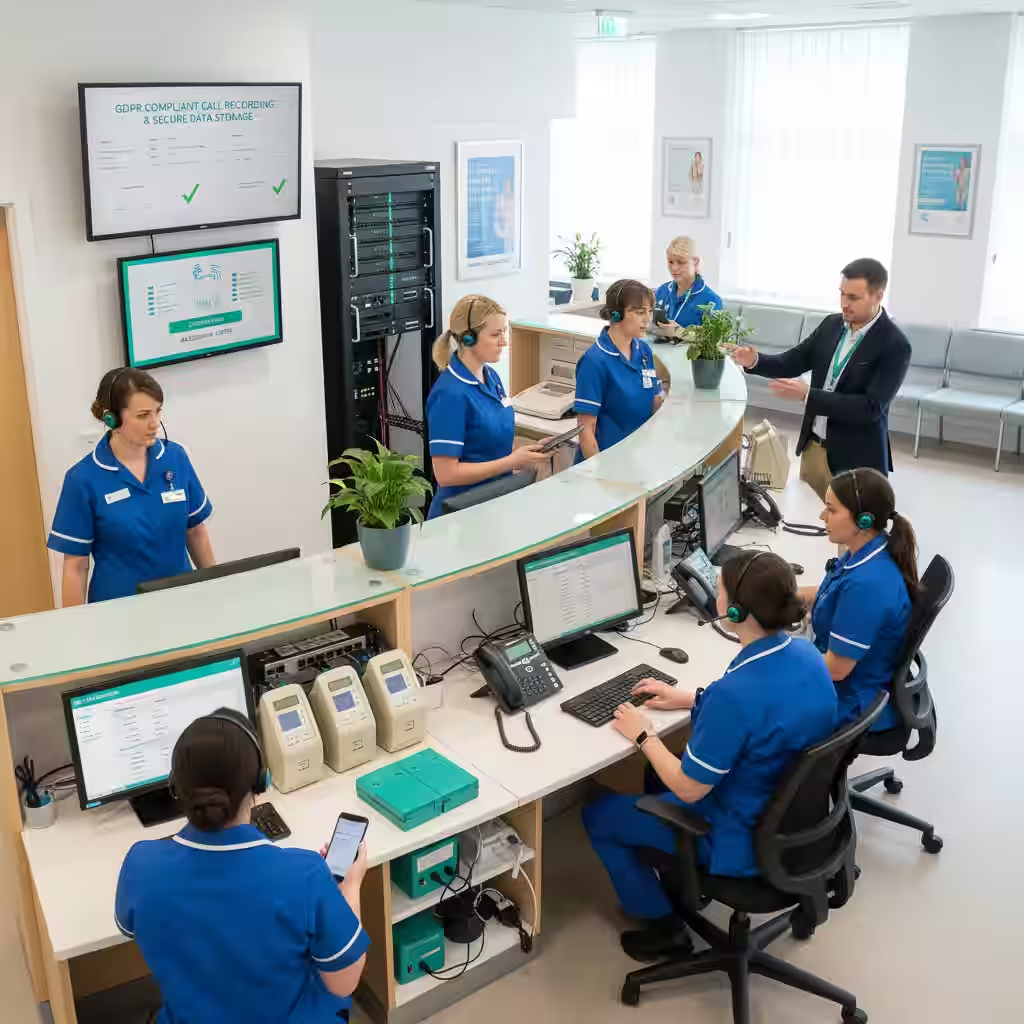
Requirements:
- PSTN-dependent medical alert systems needing replacement
- Patient confidentiality and data protection compliance
- Reliable emergency contact capabilities
- Integration with patient management systems
VoIP solutions:
- Analog Telephone Adapters (ATA) maintaining legacy medical equipment compatibility
- GDPR-compliant call recording and data storage
- 4G failover ensuring emergency call capabilities during power outages
- HL7 FHIR API integrations enabling click-to-call from patient records
AMVIA approach: Healthcare migration requires extra planning for dependent medical systems. We coordinate with medical equipment vendors, test emergency calling scenarios, and implement redundancy appropriate to care level criticality.
Requirements:
- PCI DSS compliance for payment processing over phone
- Call recording for regulatory compliance (FCA requirements)
- Fraud prevention and access control
- Business continuity and disaster recovery
VoIP solutions:
- PCI DSS-certified call recording systems with pause/resume during card capture
- SIP authentication and IP whitelisting preventing unauthorized access
- Active-active redundancy across multiple UK data centers
- Real-time replication enabling sub-minute recovery point objectives
AMVIA compliance: ISO 27001 certified infrastructure. Annual PCI DSS audits. Financial services clients receive dedicated compliance documentation supporting your regulatory audits.


Requirements:
- Multi-site communications (headquarters, stores, venues)
- Unified management across all locations
- Cost control limiting unauthorized calling
- Integration with booking/reservation systems
VoIP solutions:
- Cloud-based management portal controlling all sites centrally
- Location-specific call routing and opening hours automation
- Per-site and per-user spending limits preventing toll fraud
- API integrations triggering calls based on booking confirmations/cancellations
AMVIA scalability: Retail clients add new locations in under 30 minutes via self-service portal. Headquarters IT team manages call flows, user permissions, and reporting across 50+ sites without visiting physical locations.
On January 31, 2027, BT Openreach permanently shuts down copper-based PSTN and ISDN networks [Openreach]. This affects analogue phone lines and extensions, ISDN2 and ISDN30 circuits... Stop-sell is already in effect—you can't order new PSTN/ISDN lines as of September 2023 [BT Wholesale 2023].
Business Communications:
- Analogue phone lines and extensions
- ISDN2 and ISDN30 circuits
- Traditional PBX systems dependent on PSTN/ISDN
Critical Systems:
- Building alarm systems using phone line monitoring
- Payment terminals with dial-up connectivity
- Fax machines (though VoIP supports T.38 fax protocol)
- Door entry systems with phone-line integration
- Telecare and medical alert devices
The timeline is aggressive:
- Stop-sell already in effect nationwide—you can't order new PSTN/ISDN lines
- Existing lines will cease functioning by January 2027
- 2,000+ providers completing migrations simultaneously—engineer availability will become scarce
- Last-minute migrations risk disruption—rushed implementations introduce errors
PSTN infrastructure is literally dying. Parts are no longer manufactured, and repairs are becoming impossible. Ofcom reported that 2023 saw 20% more service incidents on the PSTN compared to 2022, resulting in a 60% increase in service hours lost to customers [UK Parliament]. Maintenance costs are unsustainable for aging copper networks.
VoIP replacement delivers superior reliability, call quality, and features while eliminating equipment that telecommunications companies can no longer properly maintain.
Delaying your VoIP migration creates compounding risks:
Resource Scarcity:
As 2027 approaches, qualified VoIP installation engineers become overwhelmed. Migration timelines extend from weeks to months. Rushed implementations introduce errors.
Negotiating Weakness:
Desperate businesses pay premium rates. Early migrators negotiate favorable terms and thorough implementations.
Testing Time Eliminated:
Parallel running and optimization require time. Last-minute migrations can't test thoroughly before old systems disconnect.
Dependency Complications:
Interconnected systems (alarms, payment terminals, door entry) need replacement coordination with multiple vendors. Rushed coordination causes gaps.
AMVIA capacity planning: We're scheduling 2026 migrations now. Businesses booking implementation slots in Q4 2024/Q1 2025 receive prioritized service, thorough testing periods, and negotiating flexibility. Those waiting until Q4 2026 face compressed timelines and reduced availability.

You have dozens of VoIP provider options. Price comparison is easy. What's harder to evaluate before signing contracts: support quality when problems arise, migration expertise preventing disruption, and genuine partnership versus transactional vendor relationships.
Direct UK Expert Access—Not Offshore Call Centers
You speak to humans within 90 seconds. Real VoIP specialists, not script-reading tier-1 agents. Our no-voicemail policy (0333 733 8050) means technical troubleshooting starts immediately—no ticket submission and waiting for callbacks.
This means: Call quality issues get diagnosed on first contact because our UK team understands SIP, codecs, and QoS configuration. You're not explaining problems repeatedly to multiple support tiers. Issue identified → Solution implemented → You're back to productive calls. Usually within 30 minutes for non-infrastructure problems.
99.9% Uptime Backed by Automatic Financial Credits
We don't just promise reliability—we guarantee it with money. Our SLA includes automatic service credits for missed uptime commitments. No claim forms or negotiations. Breach the SLA? Credits apply automatically to your next invoice.
This means: We're financially motivated to maintain infrastructure proactively. Multi-site UK data centers with active-active redundancy. 24/7 network operations monitoring. Firmware updates scheduled during maintenance windows. Your risk is our risk—that alignment matters.


2,000+ UK business migrations completed. Zero failures in 2024. Our structured migration process includes network assessment, parallel running, number porting coordination, and on-site support during cutover.
This means: Your customers don't experience call failures. Your staff don't lose productivity. Your business operates normally throughout migration. We've encountered every edge case and know how to handle them—legacy PBX peculiarities, complex call flows, dependent alarm systems, multi-site coordination. Experience matters when your communications are at stake.
Transparent Partnership, Not Transactional Sales
You get named account managers who understand your business—not anonymous ticket queues. Monthly check-ins, proactive optimization recommendations, and roadmap consultation. We know your call flows, understand your busy periods, and suggest improvements based on usage patterns we monitor.
This means: You're not on your own post-implementation. Need to add a new site? Your account manager coordinates everything. Want to integrate new CRM? We map the workflow with you. Considering Microsoft Teams calling? We assess fit for your environment and implement if beneficial. Partnership means ongoing optimization, not "figure it out yourself after installation."
We're Microsoft partners with deep Teams Direct Routing expertise. If you use Microsoft 365, we integrate VoIP calling natively into Teams—one application for messaging, meetings, and phone calls.
This means: Your investment in Microsoft licenses increases in value. Users work in familiar Teams interface instead of learning separate phone apps. IT administration simplifies—Teams admin center manages both collaboration and telephony. We configure tenant policies, provision users, and train administrators properly.
Comprehensive Connectivity Solutions
VoIP is one component of your communications infrastructure. Many businesses need business broadband upgrades, leased lines for guaranteed bandwidth, SD-WAN for multi-site optimization, or Microsoft 365 licensing advice. AMVIA provides complete connectivity solutions—you're not coordinating multiple vendors for interdependent services.
This means: One partner for internet, VoIP, Microsoft 365, cybersecurity, and mobile services. Unified support—we troubleshoot problems holistically rather than each vendor blaming others. Simplified procurement and consolidated billing. Relationship efficiency that scales as your business grows.
Proven Industry Expertise
2,000+ UK businesses across legal, healthcare, financial services, retail, manufacturing, and professional services trust AMVIA for business-critical communications. 4.6/5 Trustpilot rating. CityFibre Trusted Partner. ISO 27001 certified.
This means: We understand sector-specific requirements—legal call recording compliance, healthcare PSTN-dependent medical devices, financial services PCI DSS needs, retail multi-site management. References available from businesses similar to yours in size, industry, and technical requirements.
The PSTN switch-off is non-negotiable. Your business must migrate to digital telephony by January 2027. The question isn't whether to switch to VoIP—it's who to partner with for implementation.
Yes—number porting transfers your existing UK numbers to the new VoIP system without disruption. Geographic numbers (01, 02), non-geographic numbers (03, 0800, 0845), and mobile numbers all port seamlessly. The process takes 5-10 working days and happens without service interruption. AMVIA handles all carrier coordination and porting paperwork.
Each concurrent call requires approximately 100Kbps (0.1Mbps) for standard quality or 200Kbps for HD voice. A typical 50Mbps business broadband connection easily supports 50+ simultaneous calls. Most businesses discover their existing internet connection handles VoIP without upgrades—proper QoS configuration matters more than raw bandwidth.
Professional VoIP implementations include failover to mobile phones during outages. Inbound calls automatically divert to designated mobile numbers. Mobile VoIP apps enable staff to continue making/receiving calls via cellular data. For businesses requiring guaranteed landline access, battery backup units provide 2-4 hours of phone system operation. AMVIA configures appropriate resilience based on your business criticality.
Modern VoIP typically delivers superior call quality—HD voice codecs provide wider frequency range than traditional telephony. Call quality depends primarily on internet connection quality and proper network configuration, not VoIP technology itself. AMVIA performs bandwidth testing and QoS configuration during implementation, ensuring call quality meets or exceeds your current system. 99.9% of clients report equal or better quality post-migration.
Many SIP-compatible IP phones work with any VoIP provider, including existing equipment from previous systems. AMVIA assesses phone compatibility during discovery—compatible phones save costs while incompatible phones require replacement. Alternatively, softphone apps turn existing computers and smartphones into VoIP phones at no hardware cost. Most businesses adopt hybrid approaches: desk phones for office staff, softphone apps for remote workers.
Typical implementations complete in 4-6 weeks from kickoff to full deployment. This includes network assessment, system configuration, parallel testing, number porting, and user training. Actual service disruption measures in hours during the cutover window, not days or weeks. Businesses requiring faster deployment can compress timelines to 2-3 weeks, though this reduces parallel testing time. AMVIA prioritizes zero-downtime migrations—you remain operational throughout.
99.9% uptime allows 8.76 hours of downtime annually, or approximately 43 minutes monthly. Enterprise VoIP providers achieve this through redundant infrastructure across multiple data centers. If one data center experiences issues, traffic automatically routes via backup locations. AMVIA's 99.9% SLA includes automatic service credits if we breach uptime commitments—financial penalties guarantee accountability.
VoIP systems support full emergency services access. Modern systems transmit location data automatically during emergency calls. Mobile VoIP apps identify your current location via GPS. Desk phones associate with configured physical addresses. UK regulations require VoIP providers to offer power-failure solutions maintaining emergency service access. AMVIA configures mobile failover ensuring 999/112 accessibility even during internet outages.
Yes—mobile VoIP apps enable staff to make/receive calls using their business number from personal smartphones. This protects personal number privacy while maintaining professional image. Calls route through your VoIP system with normal call recording, reporting, and cost controls. No need for second work phones—one device handles personal and business communications separately.
Reputable providers offer trial periods or pilot programs before full deployment. AMVIA implements parallel running—new VoIP system operates alongside old phones for testing before final cutover. This eliminates surprises and enables informed go/no-go decisions. Post-migration, monthly rolling contracts provide exit flexibility if long-term fit proves poor. That said, VoIP reversals are extremely rare—technology advantages over traditional telephony are substantial.